$42,000 a year, all-in, taught in the Seoul Capital Area · Coursework recorded by a US partner institution · And four years inside the half of the world your child will work in
None of this is news to a parent doing the arithmetic. What has been missing is an option between paying all of it and giving up the degree.
About $100,000 a year, all-in, at an American private university. Four years is $400,000. Two children is $800,000. And if you are reading this, you most likely do not qualify for aid.
Tuition has outpaced inflation for four decades. Whatever you budgeted for your eldest will not cover your youngest. Families discover this in the middle, not the beginning.
Most American pre-meds finish four years having never lived or worked outside the United States. The next thirty years of medicine, research and industry will not be settled in one hemisphere. Knowing both East and West has stopped being enrichment. It is a qualification.
Minerva raised $155M establishing that an American degree needs no American campus, with Benchmark leading its seed. We run one city instead of seven, and point at one outcome that can be counted.
I arrived in the United States at sixteen, in the first year of high school, and was admitted to Harvard three and a half years later. I studied economics, have written twenty-three non-fiction books, and have spoken to roughly a million people across Korea. Two things became impossible to ignore. American higher education has priced itself past the families it claims to serve. And the American students who will lead over the next thirty years are growing up without the East — without the language, the habits, or any working knowledge of the half of the world their careers will run through. Minerva showed that the first problem has a structural answer. Seoul answers the second. Plato is built for both at once.
Incorporated in California. Finances are disclosed annually through IRS Form 990, and any surplus is reinvested in teaching rather than distributed.
Plato is not an accrediting body, is not WSCUC-accredited, and has not applied to WSCUC. The intended structure is a credit-recognition agreement with a US university that already holds that accreditation, so that the transcript is issued in that university name. Until such an agreement is signed, that structure is an intention rather than a fact.
Admissions committees care less about the name on the transcript than whether the prerequisites were completed. Biology, chemistry, organic chemistry, physics, biochemistry, psychology, sociology and statistics are all built into the programme.
Live instruction from US-based faculty is paired with resident instructors in Seoul who handle day-to-day academic support. All coursework is in English.
Pre-medical is where the school began and the only track whose curriculum is finished. Tracks in AI and computing, game development, the life sciences, pharmaceutical science, the music business, screen production and finance are in preparation. Across every track we work to place students in internships with Korean companies — an objective, not yet a feature.
Plato is an undergraduate school, so a track is a course of study and not a separate institution. Every student reads the same core — coursework in English, writing, quantitative reasoning — and then goes deep in one direction. Pre-medical is the track the school was designed around and the only one whose curriculum is finished. The rest are in preparation, and each card says so.
Every AMCAS prerequisite, a two-year MCAT sequence, and clinical observation timetabled into the academic week rather than squeezed around it. Ajou University Hospital is adjacent to the campus, and the Gangnam and Seocho medical cluster is about thirty minutes away by rail.
Machine learning, systems and software engineering, read where the hardware is made. Korea produces a large share of the world’s memory semiconductors, and the engineering employers that depend on them are inside the city rather than a flight away.
Design, engine programming and production. Korea built one of the largest game industries in the world and was the first country to treat competitive play as a professional sport. The studios and the leagues are both here.
Molecular biology, genetics and laboratory method, with research placement as the point of the degree rather than a bonus attached to it. The Songdo biocluster, about an hour from the classroom, holds some of the largest biologics manufacturing capacity anywhere.
Pharmacology, formulation, and the regulatory path a drug actually travels from laboratory to patient. Korea’s contract manufacturing sector and its density of clinical trials give students something to study that is not only a textbook.
Not performance training. The business behind it: A&R, rights and publishing, touring and live operations, and how a Korean label builds an act for an audience that was never domestic. The industry that exports this music is headquartered in this city.
Writing, production and post for the screen. Korean drama and film now reach a global audience through streaming distribution, and the production companies that make them work out of Seoul. Students read the craft and the rights structure together.
Investment analysis, fund structures, and how capital actually moves, taught where a student can watch it happen. Korea’s institutional investors and venture firms sit inside the same metropolitan area, and unpaid placements with domestic limited and general partners are the point of the track rather than something added to it. Scheduled Bloomberg Terminal time runs through all four years, with the Bloomberg Market Concepts certificate taken in the first year — a credential a recruiter already recognises. Three terminals for a cohort of twenty — a large business school runs twelve for eight thousand. Here the terminal is a desk rather than a facility. Read the full track →
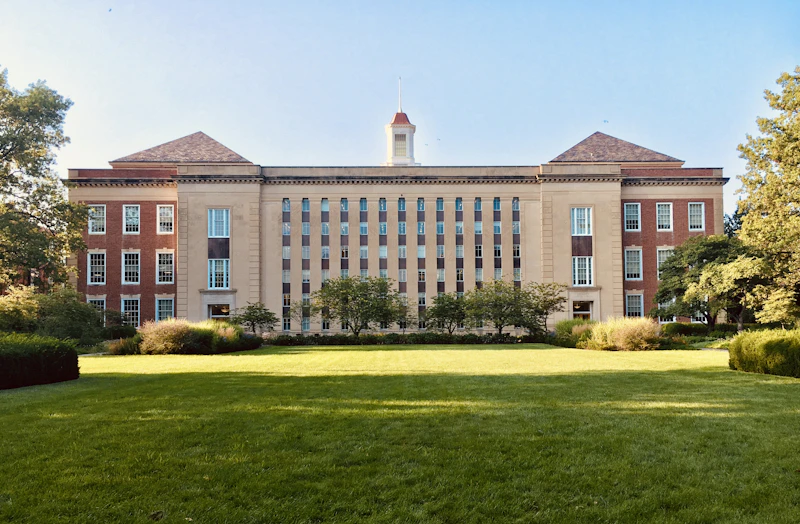
Classrooms and laboratory space in a single leased building in Gwanggyo, a planned district in Suwon. Ajou University Hospital, a tertiary teaching hospital carrying the regional cancer centre, is adjacent, so clinical hours can be timetabled into the academic week rather than squeezed around it. Gangnam is about thirty minutes away on one direct railway line. Students live where they choose — Gwanggyo, elsewhere in Suwon, or Seoul. The school does not direct that and does not pretend to.
The Gyeonggi Bio Center and Seoul National University’s Advanced Institute of Convergence Technology stand in the same district, a walk from the classroom. Pangyo, where NCSOFT, Nexon, Kakao Games and Krafton sit, is about fifteen minutes by rail. Samsung’s Suwon campus is nearby, and the labels and production companies in Seoul are about thirty minutes away. Nobody is confined to Gwanggyo. Seoul is thirty minutes away, and unpaid activity there — research placements, volunteering, society work, observation — is within reach of an ordinary week. Paid internships are a separate question and remain subject to work authorisation tied to visa status.
This section describes the pre-medical track. On a medical school application, clinical exposure and research carry as much weight as scores. Seoul makes both possible inside the undergraduate years rather than after them.
Students observe consultations under the supervision of the attending physician. Korean medical law restricts unlicensed students to observation and learning, so no invasive procedures are performed. We state that limit plainly.
Students are connected to co-authorship on papers and to conference presentations. The aim is substance in the AMCAS Work and Activities section, not a list of titles.
Programmes serve communities with limited access to care. Committees read for sustained commitment and initiative rather than for the size of any single activity.
Diagnostic testing, an individual study plan and regular full-length practice exams run across two years. The MCAT is scored against a single national standard regardless of where a student studied.
Application strategy, the personal statement, and full rehearsal of the Multiple Mini Interview format now used by roughly 60% of North American medical schools.
There are 155 MD schools in the United States. We tier the ones realistically open to international applicants and build each student a list from that, rather than applying broadly and hoping.
The right route differs from student to student. Tell us where you are academically and what you are aiming at, and we will look at it with you.
* Your details are used only for admissions correspondence and are not shared with anyone else.